Last updated
What are option grants
Stock options are one of the main ways startups turn early team members into owners. An option grant gives someone the right (not the obligation) to buy shares later at a fixed price, as they earn that equity over time.
Why use option grants
Attract and retain talent without matching big-company salaries.
Align employees and advisors with the long-term value of the company instead of just cash compensation.
Keep control: option holders are not shareholders until they exercise, so they do not vote or receive dividends before then.
In Mantle, option grants live in one place with their terms, vesting, documents, and exercise history, and the cap table updates automatically in the background.
Key concepts to know
Exercise price (strike price):
The price the holder pays per share when they exercise. This is usually set at or above the current fair market value (FMV) from your most recent 409A valuation to avoid tax issues.
Vesting:
How the grant is earned over time. A common structure is 4 years with a 1‑year cliff, then monthly vesting for the remaining 3 years.
ISOs vs. NSO:
In some jurisdictions, there are different tax treatments for “incentive stock options” and “non‑qualified stock options”. Mantle can store the type, but your lawyer and tax advisor should guide which to use.
Exercise:
When someone decides to turn their options into actual shares by paying the exercise price, usually within a set window (for example, 90 days after leaving).
Before you start issuing options
Make sure you have:
An equity incentive plan approved by your board and, where required, shareholders. You generally cannot grant stock options until the plan exists.
Standard, lawyer-reviewed grant agreements uploaded into Mantle.
Basic stakeholder details ready: name, email, role, etc.
The Shortcut: Mantle Clerk
Clerk is your AI assistant for cap tables, built directly into Mantle. Issuing options? Let Clerk know, or simply drag and drop your options documents, and Mantle Clerk will draft them for you.
Reach out to support@withmantle.com to activate Mantle Clerk for free on your account.
Creating a new option grant in Mantle
Select or add the stakeholder
Pick an existing stakeholder (employee, founder, advisor, contractor) or add a new one with their contact details.
Enter grant details
Number of options
Exercise price
Grant date
Vesting start date
The equity plan the grant sits under
Select a vesting schedule
Choose a standard schedule that matches your internal policy (e.g. "4y/1y cliff/monthly") or a custom schedule.
Issuing for Signature
Board approval
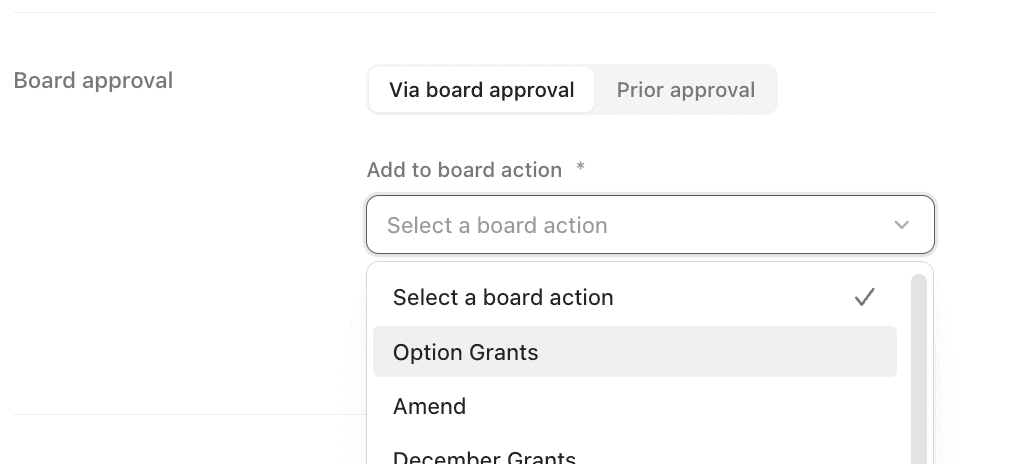
If you need to send this grant for Board approval first, select the appropriate toggle and Board Action to attach it to
Attach the signing template
Under Issuance, select your Option template (uploaded as a .docx file with substitution strings in Settings). Mantle will auto-fill fields like stakeholder name, number of options, exercise price, and vesting start date.
Send for signature
Once you save and create the draft, you can preview the document before issuing for signing. The Board Action will be sent to Board members for approval first, and then it will go to the company signatory. Once those two parties have signed, the grant will go to the recipient to sign. The recipient completes a guided signing flow. Once fully signed, Mantle marks the grant active and reflects it on the cap table.
How option grants show up on your cap table
Each grant is a separate line tied to a stakeholder and an equity plan. Mantle tracks vested vs. unvested quantities and incorporates them into ownership views and scenario modeling. This removes the need for a separate "vesting spreadsheet" as long as your grants and schedules are set up correctly in Mantle.
Things founders should watch for
Do not casually "promise" a percentage; base offers on a fixed number of options and show candidates what that means at today's fully-diluted share count.
For companies in the US, keep your exercise price in line with a current 409A valuation so employees are not surprised by unexpected tax consequences.
Use a small, consistent set of vesting schedules so you are not managing dozens of one-off deals later.